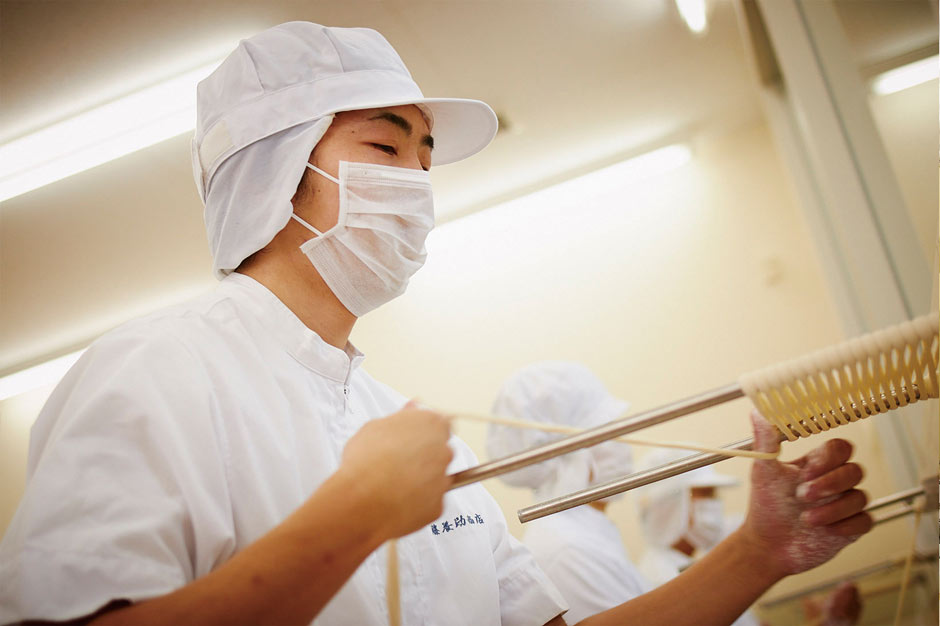
Sato Yoske Sohonten is the flagship store and working factory of one of Japan’s most celebrated udon makers, located in Inaniwa village, Yuzawa City, Akita Prefecture. Founded in 1860, the shop produces Inaniwa udon — one of Japan’s Three Great Udons — entirely by hand. Visitors can watch artisans at work through a glass-walled factory (free, weekdays only), try hand-twisting the dough in a nearby workshop (paid, reservation required), then eat a bowl on-site. Tokyo and Hong Kong locations exist, but the factory and workshop are here only.
Quick Facts
| Type | Factory tour (free) + hands-on udon-making workshop (paid) |
| Address | 80 Inaniwa-machi, Inaniwa, Yuzawa City, Akita 〒012-0107 |
| Phone | 0183-43-2911 |
| Factory tour | Free / walk-in / 9:00–16:00 / weekdays only (live demo) |
| Workshop hours | Reservations accepted 11:00–14:00 |
| Workshop booking | Required by noon the day before / call for urgent bookings |
| Workshop payment | Cash only, paid at the Sohonten on the day |
| Shop hours | 9:00–17:00 |
| Restaurant hours | 11:00–17:00 |
| Closed | Year-round (New Year period only) |
| Access | JR Yuzawa Station → car 20 min / Ugo Kotsu bus → Inaniwa Nakamachi stop, 1 min walk |
| Website | https://www.sato-yoske.co.jp/ |
What Is Inaniwa Udon?
Inaniwa udon is one of Japan’s Three Great Udons, alongside Sanuki (Kagawa) and Mizusawa (Gunma). Unlike thick, chewy Sanuki noodles, Inaniwa strands are flat, thin, and glossy — silky smooth against the throat, yet firm enough to hold a dipping broth. That distinctive texture is produced entirely by traditional hand techniques: twisting (tsubushi) and stretching (nobashi), with no machines involved at any stage.
The craft originated in Inaniwa village in the 1660s. By 1690 it had earned the endorsement of the Satake feudal lords of the Akita domain, who made it their official supplier. In 1829 an official court seal restricted use of the Inaniwa name to the founding family alone — a mark of just how prized the noodle had become.
About Sato Yoske Sohonten
In 1860, the founding family made a rare exception to their strict secrecy: to prevent the craft from dying out, they passed the technique to their fourth son, who had been adopted into the Sato family. This is the founding moment of Sato Yoske as an independent enterprise. “Sato Yoske” is a hereditary title, not a personal name — the eighth-generation head formally assumed the title in January 2025.
In 1972, the seventh-generation Sato Yoske opened the technique to craftspeople outside the family, allowing the tradition to grow from a household craft into a wider industry. In 2004, the seventh generation received the Contemporary Master Craftsman award (Gendai no Meiko) from Japan’s Minister of Health, Labour and Welfare — one of the country’s highest honours for traditional artisans.
Sato Yoske today operates restaurants and shops across Akita Prefecture, in Tokyo (Ginza, Hibiya, Asakusa), and an affiliated location in Tsim Sha Tsui, Hong Kong. All noodle production takes place at the Inaniwa factory — the only place in the world where you can watch or join the process.
Factory Tour — Free, Walk-In
The ground floor of the Sohonten main building contains a working production facility, visible through a glass wall. Explanatory panels run alongside each station; historical exhibits are displayed throughout. The space is fully barrier-free and accessible for wheelchair users.
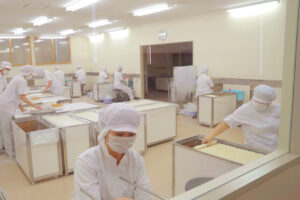
Inaniwa udon is made in four hand-only stages:
- Kneading and coiling (練る・小巻): dough is hand-kneaded, rested, cut into strips, and hand-rolled and coiled in spirals into wooden tubs
- Hand-twisting and pressing (手綯い・つぶし): the rested dough is looped onto two wooden rods and twisted by hand — the step that creates the noodle’s firm, springy bite
- Stretching and drying (延ばし・乾燥): noodles are hung on wooden frames, gently stroked to even thickness, and dried overnight
- Sorting (選別): after cutting, each noodle is checked individually by hand for uniform thickness
The live artisan demonstration runs on weekdays only. On Saturdays, Sundays, and public holidays the factory does not operate — manufacturing process panels remain on display but no craftspeople will be at work. Plan a weekday visit to see the full process in person.
- Hours: 9:00–16:00 (live demonstration weekdays only)
- Duration: Approx. 15 minutes
- Cost: Free — no reservation required
- Access: Barrier-free / wheelchair accessible
Udon-Making Experience — Paid, Reservation Required
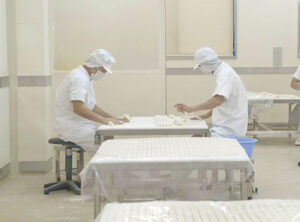
A short walk from the main building, Menya Inaniwa Yosuke Honten (20 Inaniwa-machi) hosts the hands-on workshop. Participants practice hand-twisting (手綯い) — the most physically demanding step of Inaniwa udon production. The three movements are: twisting (綯う), pressing (つぶす), and stretching (のばす). The dough is far more elastic and resistant than it looks; most visitors are surprised by the strength it requires.
After the session your dough is left to dry and finish. Completed noodles can be shipped to a Japanese address — either your home or a confirmed accommodation address for longer-stay visitors (additional shipping fee applies). Same-day take-home is not available. Overseas shipping is not available.
Workshop sessions accept 1 person minimum and up to 20 participants in rotational groups. Menu descriptions are available in English.
Course Options
| Course | Content | Duration | Junior High+ | Elementary |
|---|---|---|---|---|
| Course A | Udon-Making Experience (Hand-Twisting) | Approx. 30 min | ¥2,000 | ¥1,500 |
| Course B | Udon-Making Experience (Hand-Twisting & Artisan Techniques) | Approx. 60 min | ¥3,300 | ¥2,200 |
| Course C | Udon-Making & Cooking Experience (Hand-Twisting + Boiling) | Approx. 60 min | ¥3,300 | ¥2,200 |
Note: Reservations accepted 11:00–14:00. Book by noon the day before (email bookings: at least 2 days ahead). Course C involves open flame — children must be accompanied by an adult. On weekends and public holidays, only Course A may be available. Availability subject to factory operating schedule.
- Reception: Sato Yoske Sohonten (80 Inaniwa-machi, Inaniwa, Yuzawa)
- Workshop venue: Menya Inaniwa Yosuke Honten (20 Inaniwa-machi) — short walk from main building
- Hours: Reservations accepted 11:00–14:00
- Participants: 1 person minimum / groups up to 20 (rotational sessions)
- Book by: Noon the day before at the latest. For urgent bookings, call by phone.
- Email booking: taikenyoyaku@sato-yoske.co.jp (book at least 2 days ahead by email)
- Closed: New Year period / days when factory is not operating (incl. weekends & public holidays)
- Payment: Cash only, paid at the Sohonten on the day
- Cancellation: By noon the day before
Dining at the Sohonten
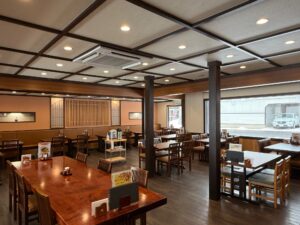
The on-site restaurant serves Inaniwa udon from 11:00 to 17:00. The most popular dish is the Futami Tempura Seiro (二味天せいろ, ¥1,850): cold udon with two dipping sauces — soy and sesame miso — alongside tempura. Hot udon and set meals with Hinai-jidori (Akita’s celebrated local chicken breed) rice are also available, ranging from approximately ¥850 to ¥2,100. The menu may be scaled back on weekends and public holidays. The shop also sells take-home noodle packages, Kawatsura lacquerware, and other Akita specialty products.
Getting There
From Tokyo, take the Akita Shinkansen “Komachi” to JR Yuzawa Station (approx. 4 hours direct — no transfer required). From Yuzawa Station, the most convenient option is to rent a car: the drive through the Inaniwa valley takes about 20 minutes. A public bus is also available (Ugo Kotsu Yuzawa-Koyasu Line, alight at “Inaniwa Nakamachi” stop, 1-minute walk), but departures are infrequent — check the timetable before visiting.
Nearby
Inaniwa Castle (稲庭城), a reconstructed hilltop fortress with panoramic valley views, is about a 5-minute walk from the Sohonten. Koyanagi Gorge (小安峡), a scenic hot-spring gorge with dramatic riverside cliffs, is about 20 minutes south by car. Both pair naturally with a visit to the Sohonten for a half-day Inaniwa itinerary.
Frequently Asked Questions
Is the Sato Yoske factory tour free to visit?
Yes. The factory tour is completely free and requires no reservation. It runs daily from 9:00 to 16:00. Note that the live artisan demonstration is available on weekdays only — on weekends and public holidays the factory is closed, but informational panels remain on display.
How do I book the Inaniwa udon-making experience at Sato Yoske?
Call 0183-43-2911, or email taikenyoyaku@sato-yoske.co.jp. Book by noon the day before your visit. If booking by email, allow at least two days as response times vary; for last-minute reservations a phone call is strongly recommended.
Is the udon-making experience available on weekends?
Course A may be available on weekends and public holidays. Courses B and C require the factory to be operating and cannot be booked on weekends or public holidays. Availability is subject to the factory schedule — call ahead to confirm.
Can I take the noodles I make home on the same day?
No. The noodles need time to dry and finish after the session. Once complete, they can be shipped to a Japanese address — your home, or a confirmed accommodation address such as a hotel (shipping fee applies). Overseas shipping is not available.
How many people can join the workshop?
Sessions are available for 1 person minimum. Groups of up to 20 participants are accommodated in rotational sessions.
How long does the factory tour take?
Approximately 15 minutes for the tour itself, though you can spend longer reading the historical exhibits and manufacturing panels at your own pace.
Where else can I eat or buy Sato Yoske udon?
Sato Yoske operates restaurants and shops across Akita Prefecture, in Tokyo (Ginza, Hibiya, Asakusa), and runs an affiliated restaurant in Tsim Sha Tsui, Hong Kong. Noodles are also available through the official online shop. The factory tour and udon-making workshop, however, are exclusive to the Inaniwa Sohonten.
Is Sato Yoske Sohonten wheelchair accessible?
Yes. The factory tour area is fully barrier-free and accessible for wheelchair users.
Why Make the Trip?
Sato Yoske’s noodles have reached Tokyo and Hong Kong, but the craft itself has never moved. The same hand-twisting technique that earned this village the patronage of the Akita feudal lords in 1690 still runs in this factory every weekday morning. Watching a craftsperson loop dough onto wooden rods with practiced speed — or feeling the surprising resistance of that dough when you try it yourself — is a direct encounter with a food tradition that has outlasted empires, wars, and the industrialisation of almost everything around it. That kind of continuity is rare anywhere in the world, and worth the detour.