Most visitors come to Hakone for hot springs, mountain scenery, and the famous pirate ship on Lake Ashi. But halfway up the mountain, inside one of Japan’s oldest Western-style parks, there’s a place where you can slow down, work with your hands, and leave with a one-of-a-kind souvenir you made yourself.
Hakone Craft House sits inside Hakone Gora Park — a French formal garden that opened in 1914 and is now over 110 years old. The park itself is worth a visit: a hillside lined with symmetrical fountains, seasonal roses, hydrangeas in early summer, and fiery autumn leaves. At its heart is a craft studio where professional artisans guide you through real Japanese crafts, from glassblowing to ceramics. Among all the workshops on offer, one stands out for visitors who want a genuine hands-on experience with a traditional art form: kiriko — Japanese cut glass
Why Kiriko?
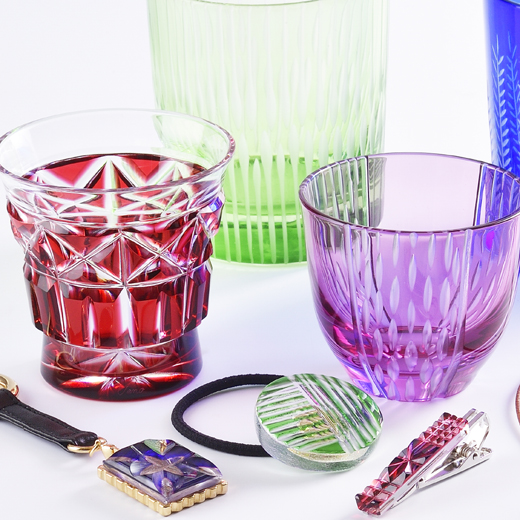
Kiriko is a traditional Japanese cut-glass technique that dates back to the late Edo period, the early 1800s. Craftsmen carve fine grooves and geometric facets into layers of colored glass, creating intricate patterns that catch and scatter light. The transparent glass beneath glows through the cuts, giving each piece a depth that shifts with every angle. Historically produced in Tokyo (Edo Kiriko) and Kagoshima (Satsuma Kiriko), the craft has been admired for centuries — and at Hakone Craft House, you get to try it yourself under the guidance of a skilled kiriko artisan.
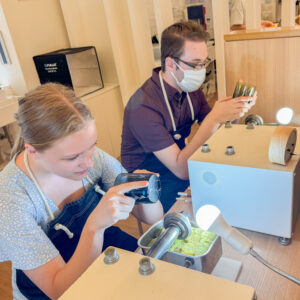
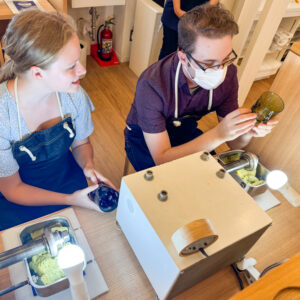
This isn’t a watch-and-learn demonstration, and you’re not painting a pre-made item. You’re the one sitting at the cutting wheel, grinding patterns into glass, feeling the vibration travel through your fingertips as each line takes shape. It’s precise, absorbing work — an hour passes before you notice — and what you hold at the end is something no one else has.
What the Experience Is Like
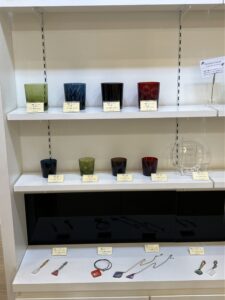
The kiriko studio is upstairs on the second floor of the main building. When you arrive, you start by choosing your glass from a range of colored vessels and accessories — tumblers, small dishes, pendants, and more. Each one comes in rich hues: cobalt blue, deep red, emerald green.
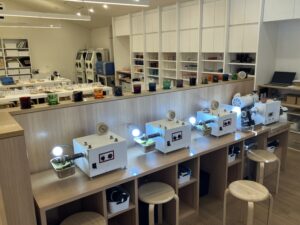
A kiriko craftsman guides the session closely, walking you through the process (sessions run in small groups, with one instructor for up to eight guests). You hold your chosen glass against a dedicated diamond cutting wheel, and the artisan guides your hands as you grind each line into the surface. The first cut feels tentative; by the third or fourth, you start to feel the rhythm. The craftsman adjusts your angle, suggests where to place the next line, and helps you build a pattern that comes together piece by piece.
No experience is needed. The staff are used to working with complete beginners, and they’ll adjust the difficulty to your comfort level (ages 11 and up). Plan on about 60 minutes of hands-on cutting, with roughly 30 minutes more for check-in and design selection.
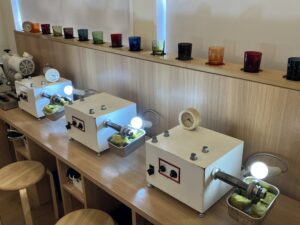
Three Courses to Choose From
- Accessory Course — Cut a small glass pendant or accessory. A quick, satisfying introduction to the craft. Take it home the same day (allow about 30 minutes for assembly).
- Standard Course — Cut your own drinking glass or small vessel. More surface area means more room for pattern work. Take it home the same day.
- Premium Course — For those who want a more refined piece. After you finish cutting, the kiriko craftsman applies a professional final polish, bringing out a deeper clarity in the glass. Because of this finishing step, the Premium piece is shipped to you afterward.
Why “Same-Day Takeaway” Matters
If you’ve tried craft workshops elsewhere in Japan, you know the routine: you shape something on a pottery wheel, and then it needs to be fired, glazed, fired again, and shipped weeks later. For travelers on a tight schedule — or anyone who wants to hold their finished work in their hands — that delay can be a dealbreaker.
Kiriko sidesteps that entirely. Because you’re cutting into finished glass rather than shaping raw material, the Accessory and Standard courses produce a completed piece the moment you lift it from the wheel. The staff wrap it for you, and you walk out with it. No shipping address, no waiting, no extra cost. It’s a real, finished souvenir of your day in Hakone, made by your own hand.
The Setting: Hakone Gora Park
The setting helps, too. Hakone Gora Park opened in 1914 as Japan’s first French formal garden — it’s now over 110 years old. Built on a hillside in the Gora hot-spring district, the park is laid out with symmetrical flower beds climbing the slope, a central fountain, a rose garden with around 1,000 bushes, and a tropical greenhouse. In spring, cherry blossoms and azaleas fill the terraces; in June, hydrangeas line the walking paths; in autumn, the maples above the fountain turn vivid red and orange.
There’s also Hakuundo Tea House, a registered cultural property nestled among boulders and trees on the park grounds, where you can experience a traditional tea ceremony. And Cafe Pic, overlooking the fountain, serves light meals and the park’s signature curry.
The craft workshop fits naturally into a half-day spent wandering the park — make your glass in the morning, stroll the gardens, have lunch at the café, and pick up some Hakone-made souvenirs at the on-site shop Komamonoya Hakone before you leave.
Good to Know
| Price | From ¥4,400, varies by item (glass tumblers & vessels from ¥4,950); plus Gora Park admission ¥650, free with a Hakone Free Pass |
| Duration | About 60 min of cutting (plus ~30 min for check-in and design selection) |
| Ages | 11 and up |
| Hours | 10:00–17:00, last entry 16:30 (9:30–17:00 in peak season) |
| Take-home | Same day for Accessory & Standard courses; Premium is shipped |
| Language | English-speaking support available |
| Location | 2F, Hakone Craft House, inside Hakone Gora Park |
Getting There
From Shinjuku, ride the Odakyu Romancecar straight to Hakone-Yumoto — no transfers, about 85 minutes, reserved seats the whole way. Switch to the Hakone Tozan Railway, a charming mountain line that climbs through switchbacks and is a sightseeing highlight in its own right (watch for hydrangeas along the tracks in June). The ride to Gora takes about 40 minutes.
From Gora Station, it’s a 10-minute uphill walk to the park. If you’d rather skip the hill, take the Hakone Tozan Cable Car one stop to Koen-shimo Station and walk about five minutes to the park entrance.
Tip: If you’re using a Hakone Free Pass, the cable car ride is included and Gora Park admission is free — so the only cost is the workshop itself.
Other Workshops at Hakone Craft House
Kiriko is the headline, but Hakone Craft House offers several other hands-on experiences under the same roof. As with kiriko, each experience below requires roughly 30 extra minutes for check-in and design selection beyond the times listed. If you’re visiting with a group and everyone wants to try something different — or if you have time for a second round — here’s what else is available:
- Glassblowing (from ¥5,280, ~15 min) — Work with molten glass alongside a craftsman to blow and shape your own cup or vase. Choose your colors and patterns, and the staff handle the hot work with you. Open to ages 4 and up (with an adult). Shipped only — the glass needs hours to cool slowly.
- Lampwork Beads / Tonbo-dama (from ¥3,190, ~15 min + 50 min cooling + 30 min assembly) — Melt colored glass rods over a burner and wind them into small decorative beads, then assemble them into a necklace or bracelet. A beautiful, wearable keepsake. Take home the same day.
- Sandblasting (from ¥3,520, ~60 min work + ~30 min processing by staff) — Choose from over 100 sticker designs, arrange them on a glass, and blast the exposed surface with fine sand to etch a frosted pattern. Great for younger visitors or anyone who wants a more relaxed session. Take home the same day.
- Pottery Wheel (from ¥5,060 incl. firing fee, ~40 min) — Throw a bowl or cup on an electric pottery wheel with an instructor’s help. Shipped only (about two months for firing and glazing).
- Pottery Painting (available on select days) — Paint your own design onto a pre-made ceramic piece. A gentler option for kids or anyone who prefers drawing to sculpting.
- Laser Engraving (seasonal / may be suspended during peak periods) — Engrave a photo or design onto glass, wood, leather, and other materials using a precision engraving machine for a modern keepsake.
That range is hard to find under one roof. A family of four could split up — one at the cutting wheel, one blowing glass, one at the sandblaster, one painting pottery — and meet up afterward to compare what they made.
FAQ
Can beginners do this?
Absolutely. A kiriko craftsman guides the session closely (groups of up to eight guests share one instructor), so no prior experience is needed.
Can I really take it home the same day?
Yes, on the Accessory and Standard courses. The Premium course is polished by the craftsman and shipped to you.
Is it suitable for children?
The kiriko experience is open to ages 11 and up. For younger children, sandblasting (all ages with adult supervision) and glassblowing (ages 4+) are great alternatives.
Is English supported?
Yes — English-speaking support is available.
Do I need a reservation?
Walk-ins are accepted for individuals when space allows, but advance reservations are recommended, since reservation holders are given priority.