A Shinkansen pulling into the station looks almost impossible. That long white nose, the eerie quiet as 700 tons of train glides to a stop with the doors landing exactly on the platform markings—not approximately, exactly. Seven minutes later, a cleaning crew has transformed every seat, headrest cover, and tray table. Then it leaves at 14:47. Not 14:46. Not 14:48. 14:47.
The Shinkansen has been running since 1964 without a single fatal accident. Its average annual delay is under one minute. It travels at 320 km/h while you can balance a coin on the tray table. For most first-time visitors to Japan, riding it is one of the highlights of the trip—not just a way to get between cities, but an experience in itself.
Here’s everything you need to know before you board.
Shinkansen Lines and Train Types
Tokaido Shinkansen — Tokyo to Osaka (The Classic Route)
The most famous and busiest Shinkansen line. Most first-time visitors to Japan will ride this route between Tokyo, Kyoto, and Osaka.
Nozomi (のぞみ) — Fastest. Tokyo to Kyoto in 2 hours 15 minutes. Fewest stops. Not covered by the standard JR Pass — this surprises a lot of travelers. Individual fare: around ¥14,170 Tokyo–Kyoto.
Hikari (ひかり) — Semi-express. Tokyo to Kyoto in about 2 hours 45 minutes. Fully covered by JR Pass. Only 30 minutes slower than Nozomi—an easy trade-off if you have the pass.
Kodama (こだま) — Stops everywhere. Tokyo to Kyoto in around 3 hours 50 minutes. Cheapest option, fully JR Pass covered. Good for reaching smaller stations or if you’re not in a hurry.
Sanyo Shinkansen — Osaka to Fukuoka
Extends west from Osaka through Hiroshima to Hakata (Fukuoka). The Sakura and Mizuho trains serve this line—Mizuho is the fastest but, like Nozomi, not covered by the standard JR Pass. Osaka to Hiroshima takes about 1 hour 30 minutes; Hiroshima to Hakata about 1 hour 10 minutes.
Other Major Lines
Tohoku Shinkansen runs from Tokyo north through Sendai to Aomori, with the Hayabusa reaching 320 km/h—the fastest in regular service. Tokyo to Sendai takes around 1 hour 30 minutes. Fewer international tourists means a more local feel.
Hokuriku Shinkansen connects Tokyo to Kanazawa in around 2 hours 30 minutes through spectacular mountain scenery. Kanazawa is consistently one of Japan’s most underrated cities for travelers.
Kyushu Shinkansen links Hakata (Fukuoka) to Kagoshima in about 1 hour 20 minutes, with distinctive red train interiors designed by renowned industrial designer Eiji Mitooka.
The Speed — What It Actually Feels Like
Smoother than you expect. The noise is surprisingly low, the ride almost meditative. The speed doesn’t register until you look out the window and watch the countryside blurring past. Mount Fuji appears on the right side when traveling from Tokyo toward Kyoto, roughly 45–60 minutes in near Shin-Fuji station—but it’s often obscured by clouds. Don’t build your trip around catching it; treat it as a bonus if you do.
Special Trains Worth Knowing About
Hello Kitty Shinkansen — Ended May 17, 2026
For eight years, a pink-wrapped Kodama on the Sanyo Shinkansen line between Shin-Osaka and Hakata carried Hello Kitty fans and curious travelers past Hiroshima at 285 km/h. Car 1 was entirely given over to a Hello Kitty shop and photo spots. Car 2 had pink seats and a Hello Kitty conductor statue. Adults lost their composure over bento boxes. It was exactly as ridiculous and delightful as it sounds.
JR West retired the train on May 17, 2026, after eight years of service. If you’re reading this hoping to ride it—unfortunately it’s gone. But it ran a good, gloriously weird race, and the 500 series train that carried it is still one of the most visually distinctive Shinkansen designs on the network.
Doctor Yellow — A Rare Sighting
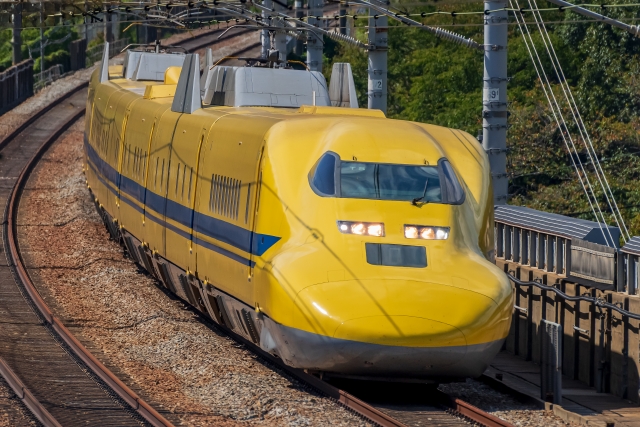
Doctor Yellow is the bright yellow diagnostic train that checks Shinkansen track conditions. It doesn’t carry passengers, runs on an unpublished schedule roughly once every ten days, and is considered good luck to spot—the rail equivalent of finding a four-leaf clover. JR Central’s version made its final run in January 2025. JR West’s version is still operating on the Sanyo line and is scheduled to retire by 2027, so sightings are still possible—just increasingly rare.
Tickets, Passes, and What to Book
JR Pass — The Big Decision
The Japan Rail Pass covers unlimited travel on most JR trains including Shinkansen (except Nozomi/Mizuho) for 7, 14, or 21 consecutive days. A 7-day Ordinary pass costs ¥50,000. It’s worth it for multi-city itineraries with multiple long Shinkansen legs—Tokyo to Kyoto round trip alone (¥27,940) doesn’t justify ¥50,000, but add Hiroshima, Fukuoka, day trips, and airport access and the math changes quickly.
For a full breakdown of whether the pass suits your specific itinerary, see our JR Pass Complete Guide 2026.
Individual Tickets
Buy at any station ticket machine (English available) or JR Ticket Office (the green 緑の窓口 / Midori no Madoguchi windows). Reserved seats cost slightly more than non-reserved but guarantee you a seat. During Golden Week, Obon (mid-August), and New Year, always reserve—trains fill completely.
Key fares for reference: Tokyo–Kyoto Hikari ¥13,970, Tokyo–Hiroshima ¥18,040, Tokyo–Hakata ¥22,220.
Regional Passes
If your trip focuses on one region, JR regional passes often deliver better value than the nationwide pass. The JR Kyushu Pass, JR West Kansai Wide Area Pass, and JR East Pass each cover their respective areas at a fraction of the nationwide pass cost. Worth researching if your itinerary stays within one region.
The Shinkansen Experience
At the Platform
Shinkansen platforms are separate from regular local train platforms—follow the blue Shinkansen signs. Floor markings show exactly where each car door will stop. Passengers queue in neat lines at these markings. When the train arrives, it stops with the doors at exactly those positions. Watch the cleaning crew: they have seven minutes to clean the entire train, and they do it as choreographed performance art. It’s worth arriving early just to see it.
On Board
Seats are comfortable with decent legroom, reclining backs, tray tables, and reading lights. Bathrooms are clean by any standard. Newer trains have power outlets and WiFi. Eating is completely normal—picking up an ekiben (station bento box) before boarding is a genuine Japanese travel tradition. Drinking is fine too. Phone calls are considered impolite; step into the vestibule between cars if you need to talk.
Luggage
Small bags go in overhead racks. Large suitcases go behind the last row of each car. On newer trains, there are dedicated luggage spaces at the back of certain cars—these require an advance reservation for oversized bags when booking. If you’re moving hotels between cities, consider using Japan’s luggage forwarding service (takkyubin/kuroneko): ¥1,500–2,500 sends your bag to your next hotel, delivered by the next morning.
Practical Tips
Book window seats early. Madogawa (窓側) seats go fast, especially on popular routes. Aisle seats are tsūrogawa (通路側) if you need easier access.
Don’t try to board Nozomi with a JR Pass. Always check the train name before the platform. Hikari takes 30 minutes longer—entirely worth the saving.
Be there before departure. Shinkansen depart at the time printed on your ticket. If it says 14:47, the train leaves at 14:47. Not 14:48.
Green Car vs. Ordinary. Ordinary class is genuinely comfortable for most journeys. Green Car offers more space and a quieter car but costs around 30–50% more. Unless you’re doing a very long journey or traveling during extreme peak times, Ordinary is fine.
Non-reserved seats. Cheaper and flexible, but you might stand on busy routes. During off-peak travel, usually fine. During Golden Week or Obon, always reserve.
Recommended Articles↓↓
- JR Pass Complete Guide 2026: Is It Worth It for Your Trip?
- Tokyo Station to Narita Airport: All Your Transport Options
- One Perfect Day in Kumamoto
FAQ: Japan’s Shinkansen Bullet Train
How fast does the Shinkansen go?
Maximum speed is 285–320 km/h depending on the line, with the Tohoku Shinkansen’s Hayabusa reaching the fastest regular service speed at 320 km/h. Cruising speed is typically 240–285 km/h. Despite the numbers, the ride feels remarkably smooth—quiet enough to have a normal conversation, stable enough to balance a coin on your tray table.
Can I use a JR Pass on the Nozomi Shinkansen?
No—the standard JR Pass doesn’t cover Nozomi or Mizuho trains. You need to take the Hikari or Sakura instead, which are only 20–45 minutes slower and are fully covered. A supplement ticket exists to board Nozomi with a JR Pass (around ¥4,960 Tokyo–Kyoto), but paying it defeats the point of having the pass.
Do I need to reserve a seat on the Shinkansen?
Not always. Non-reserved cars exist on most Shinkansen trains and are first-come, first-served. However, reservations are strongly recommended during Golden Week (late April–early May), Obon (mid-August), New Year, and on popular long-distance routes. JR Pass holders can reserve seats for free at any JR Ticket Office—always worth doing for peace of mind.
How do I see Mount Fuji from the Shinkansen?
Sit on the right side (window seat, A seat) traveling from Tokyo toward Kyoto. Mount Fuji appears roughly 45–60 minutes in, near Shin-Fuji station. The viewing window lasts only a few minutes and the mountain is frequently hidden by clouds. Best visibility is winter mornings with clear skies. If you miss it, don’t stress—it’s a bonus, not the main event.
What is the difference between reserved and non-reserved Shinkansen seats?
Reserved seats cost a small premium but guarantee your specific seat on a specific train. Non-reserved seats are cheaper and more flexible but mean first-come, first-served seating in designated cars—during peak periods you may end up standing. For most off-peak travel, non-reserved is fine; for holiday travel or with luggage, always reserve.
Is the Hello Kitty Shinkansen still running?
No. The Hello Kitty Shinkansen made its final run on May 17, 2026, after eight years of service on the Sanyo Shinkansen line between Shin-Osaka and Hakata. JR West retired the train as part of changes to the 500 series fleet. It was a genuinely fun experience while it lasted.
What happened to Doctor Yellow?
JR Central’s Doctor Yellow made its final run on January 29, 2025. JR West’s version is still operating on the Sanyo Shinkansen line and is scheduled to retire by 2027—so sightings are still possible, just increasingly rare. Spotting it is still considered good luck by Japanese rail fans. Both companies are replacing track inspection functions with sensor-equipped N700S passenger trains.
Is the Shinkansen safe?
It has operated since 1964 without a single passenger fatality—one of the most remarkable safety records in transportation history. The trains are equipped with earthquake detection systems that automatically halt service when seismic activity is detected. Average annual delay is under one minute across the entire network.
Last updated: May 2026. Shinkansen fares and schedules are subject to change. Hello Kitty Shinkansen ended operations May 17, 2026. Doctor Yellow (JR West) scheduled for retirement by 2027. Always check JR’s official site for current timetables before traveling.