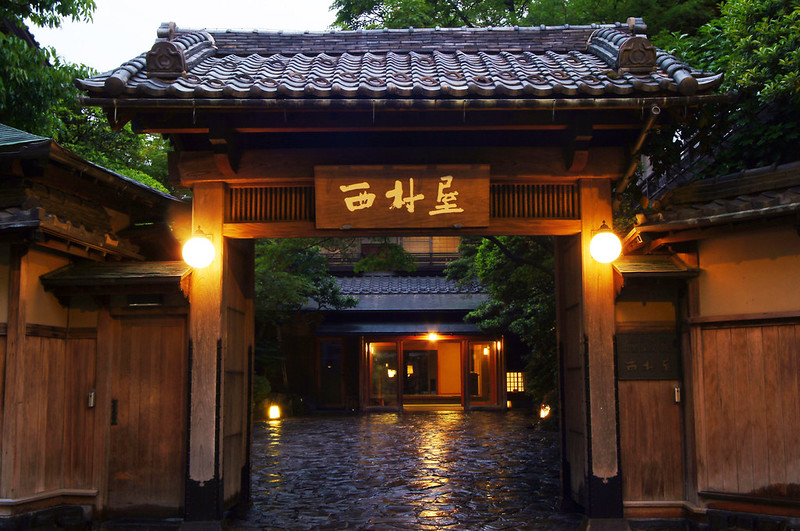
In Kinosaki Onsen, a hot spring town on Japan’s San’in coast with over 1,300 years of history, Nishimuraya Honkan
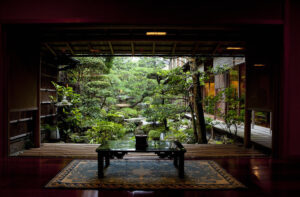
has welcomed guests since the Ansei era of the late Edo period — more than 165 years and six generations of the same family. The wooden ryokan sits within short walking distance of the willow-lined Otani River, centered around a peaceful Japanese garden of ancient pines and koi ponds viewed from select guest rooms. But what makes a stay here different from almost anywhere else in Japan is not only the ryokan itself: it is the town around it. Kinosaki Onsen operates as a single, unified hot spring resort, and guests staying at any of its ryokan are given a free pass to stroll between all of the town’s public bathhouses — dressed the whole time in a rented yukata and geta sandals.
Quick Facts
| Type | Traditional wooden ryokan (hot spring inn), with a modern sister hotel nearby |
| Address | 469 Yushima, Kinosaki-cho, Toyooka City, Hyogo 669-6101 |
| Phone | +81-796-32-2211 (front desk) / +81-796-32-4895 (reservations, 9:00–19:00 JST) |
| Founded | Ansei era, late Edo period — 165+ years, six generations |
| Guest rooms | 26 rooms |
| Check-in / Check-out | 15:00–18:00 / 7:30–11:00 |
| Minimum age | 10 years old (children 0–9 cannot stay) |
| In-house baths | 3 (Kichino-yu, Fukuno-yu, Shouno-yu) |
| Public bath access | Free pass to Kinosaki Onsen’s 6 public bathhouses |
| Cuisine | Seasonal kaiseki (April–November); Matsuba crab course (November 7–March 31) |
| Access | Approx. 2.5 hrs from Kyoto or Osaka by limited express train; approx. 15–20 min walk from Kinosaki Onsen Station, or free shuttle |
| Parking | Free valet parking |
| Payment | Cash, JCB, Visa, Mastercard, Amex, Diners, UnionPay, Alipay |
| Recognition | Relais & Châteaux, Virtuoso Preferred, Michelin 2 Key |
| Website | nishimuraya.ne.jp/honkan/en |
Room rates vary by season, room type, and meal plan — please check the official website for current pricing.
The Real Draw: A Town That Behaves Like One Big Ryokan
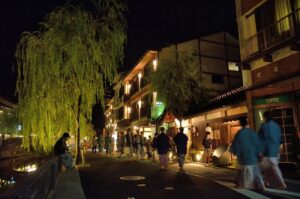
Kinosaki Onsen is unusual even by the standards of Japan’s hot spring towns. Rather than guests being restricted to their own accommodation, the whole town operates under a shared culture: guests staying anywhere in Kinosaki can step outside in a yukata and wander the streets, dipping into whichever of the town’s six public bathhouses catches their eye. Each bathhouse has its own architecture and its own blessing — one for good fortune, one for beauty, one for healing, one for a lifetime wish — so visiting several in one evening becomes as much a cultural walk as a bathing routine. Willow trees line the canal that runs through the town center, arched footbridges cross it at intervals, and in the evening the bathhouse lanterns light up the stone-paved streets. It’s a scene that has drawn Japanese literary figures for well over a century, most famously novelist Shiga Naoya, whose 1917 short story “At Kinosaki” is still associated with the town today.
Two Ways to Stay: Honkan and Shogetsutei
The Nishimuraya name encompasses two unique, family-managed properties. Guests can travel between them with a brief stroll or a complimentary transfer, and manage all booking needs through a single source.
Nishimuraya Honkan: Six Generations in the Same Wooden Building
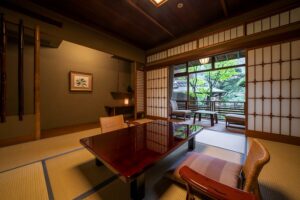
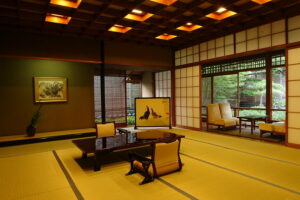
Honkan is the original house, and it still runs the way a family ryokan of this age tends to: quietly, and around its own rhythms rather than a hotel’s. Selected guest rooms look onto a central Japanese garden of old pine trees, clipped hedges, and koi ponds, while the Hiratakan Annex showcases the refined sukiya-zukuri style originally developed for tea masters. Room styles range from the Traditional Room and Traditional Superior Room, through Western & Japanese mixed rooms, to individually named suites — Matsu, Botan, Ginsen, Horai, Kangetsu, Kumoi, Honjin — several of which come with their own open-air bath, including the Hatsune, Asuka, and Sakura rooms.
The Hiratakan, an annex built by master architect Masaya Hirata, is registered as a tangible cultural property of Japan, and guests can walk through it as part of the ryokan grounds rather than viewing it from behind a rope. In the main lobby, Seigetsuro blends antique European furniture with traditional Japanese woodwork. While it might sound eccentric in theory, the actual space feels less like a modern concept room and more like an authentic, historic parlor. Connected to the property, a two-story museum holds works the family has kept since the ryokan’s founding: calligraphy and paintings by Shikō Munakata and Hirobumi Itō among others, pottery by Rosanjin Kitaoji and Kanjiro Kawai, and local pieces including Kinosaki straw craft and Tanba and Izushi ware.
Bathing at Honkan happens across three in-house baths — Kichino-yu, Fukuno-yu, and Shouno-yu — typically before or after the evening’s circuit of the town’s public bathhouses. Dinner is served kaiseki-style in the guest room or in a private dining room (for larger groups). Breakfast is served in the historic Senrei Dining Hall of Nishimuraya Honkan.
Nishimuraya Hotel Shogetsutei: A Modern Ryokan Built Against a Mountain Forest
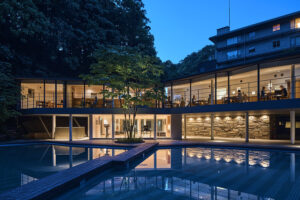
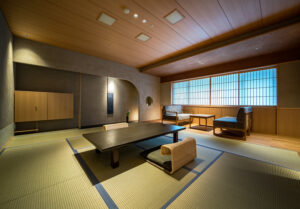
Located a brief walk or complimentary transfer from Honkan, Shogetsutei is nestled against a lush, 132,000-square-meter mountain forest. While the exterior presents a contemporary, seven-story facade, the interior is a masterclass in modern comfort steeped in ryokan tradition—complete with tatami-mat guest rooms, expansive hot spring baths, and seasonal kaiseki dining. Beyond these classic hallmarks, the property elevates the experience with an array of premium amenities.
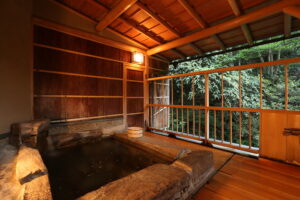
The bathing culture is built differently here too. Beyond the shared natural hot spring baths — four types, covering indoor, outdoor, a cold plunge, and a dry sauna — Shogetsutei runs three separate private onsen spas (private hot spring baths), each in a different style: Gingetsu (Japanese), Fu-Ro (Balinese), and Rinsen (Chinese). A relaxation salon, Fuka, adds aroma treatment massage on top of the bathing. None of this exists at Honkan, which is why Honkan guests can book time at Shogetsutei’s private onsen spa or Fuka in advance rather than having to choose one property over the other for the whole stay.
The property’s culinary options follow a similar dual layout. Shogetsutei’s own kitchen prepares seasonal kaiseki, while Western-style cuisine is served at Restaurant Ricca—the property’s forest-side dining offering an intimate, atmospheric alternative to kaiseki, which is served either in private dining rooms or the guest room (Japanese-style rooms only). Just a ten-minute walk or short transfer away, Sanpou Nishimuraya provides an entirely different experience: a Japanese restaurant centered around a lively irori hearth kitchen that showcases Tajima beef, fresh seafood, and local vegetables, topped with a private upstairs lounge. Beyond dining, Shogetsutei features amenities rare for the area. From mid-July to late August, guests can enjoy an outdoor garden pool—a luxury unmatched by any ryokan in central Kinosaki—alongside an on-site fitness gym for those who don’t want to leave their routine entirely behind.
Which Property Fits Which Trip
Neither property is meant to replace the other; they’re two answers, from the same family, to slightly different questions. A guest who wants the version of Japan that looks the way it does in old woodblock prints — winding atmospheric corridors, quaint & natural views from their tatami-mat room, dinner served dish by dish in the privacy of their guest room — will find that largely untouched at Honkan. While a guest who wants a similar experience but with extra space and modern conveniences & services such as rentable private hot spring baths & aroma treatment massages will certainly feel spoiled at Nishimuraya Hotel Shogetsutei. Or, like some guests do (especially those staying multiple nights), it is also possible to stay at one property while enjoying some of the facilities at the other property.
TIP: Both ryokan have irregular maintenance and staff rest closure days, so if you want to enjoy the facilities of one ryokan while staying at the other, be sure to inquire ahead of time.
Cuisine: Tajima’s Seasonal Table
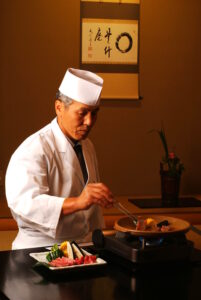
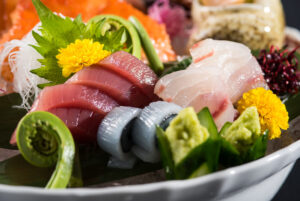
Both Nishimuraya Honkan and Nishimuraya Hotel Shogetsutei offer culinary experiences deeply tied to the seasons. From April through November, Nishimuraya Honkan, Nishimuraya Hotel Shogetsutei, Restaurant Ricca, and Sanpou Nishimuraya highlight the local area with seasonal menus built around fresh ingredients from northern Hyogo’s Tajima region; at Honkan, Ricca, and Sanpou, Tajima beef is also featured in most menus. For those craving Tajima beef — the legendary breed from which Kobe beef originates — upgraded menus are available at Shogetsutei. Then, from November 7 through March 31, the focus shifts to coveted Matsuba crab. Sourced directly from local Sea of Japan fishing ports, this male snow crab is showcased across multiple courses — from delicate sashimi to comforting hot pots — utilizing virtually every part of the crab, including the rich kani miso (crab innards).
TIP: To discover and book the dining plan most suitable for you, always book on the official Nishimuraya website. The widest range of options and best rates are available there, and you can contact Nishimuraya directly with questions or booking assistance.
History and the Nishimuraya Museum
Nishimuraya Honkan has operated on this site since the Ansei era of the Edo period, more than 165 years ago, and Kinosaki Onsen itself has drawn travelers for over 1,300 years. Guests can browse the ryokan’s own museum, a two-level collection built up over six generations, with calligraphy and paintings by artists including Shikō Munakata and Hirobumi Itō, pottery by Rosanjin Kitaoji and Kanjiro Kawai, and local crafts such as Kinosaki straw work and Tanba and Izushi ware.
Getting There
Kinosaki Onsen is reached by JR limited express train: approximately 2.5 hours from Kyoto (Ltd. Express Kinosaki) or Osaka (Ltd. Express Konotori), or about 2 hours from Himeji (Ltd. Express Hamakaze). Reservations are required for limited express seats. From Kinosaki Onsen Station, it’s about a 15–20 minute walk to Nishimuraya Honkan, a 25–30 minute walk to Nishimuraya Hotel Shogetsutei, or guests can use the Ryokan Association’s free shuttle bus that meets certain limited express arrivals (advance notice of arrival time is requested). Free valet parking is available for guests arriving by car; Nishimuraya is roughly 18 minutes from the Toyooka-Izushi interchange on the expressway network connecting to Osaka, Kobe, and Kyoto.
Good to Know
- Age policy: The minimum age to stay at Nishimuraya Honkan is 10 years old; children under 10 cannot be accommodated. Restaurant Ricca also welcomes guests 10 and older (though no children’s menu is available). Guests of all ages are welcome at Nishimuraya Hotel Shogetsutei and Sanpou Nishimuraya.
- Public bath pass: Guests receive a free pass (“yumepa”) to all of Kinosaki’s public bathhouses at check-in. The pass is valid from 14:00 on the check-in day until 13:00 on the check-out day (check-out is 10:00 am at Nishimuraya Hotel Shogetsutei and 11:00 am at Nishimuraya Honkan).
- Language support: Nishimuraya maintains staff dedicated to serving international guests; contact the ryokan in advance with any specific requests (in Japanese or English).
- Baggage: Baggage storage/transfer is available at the Kinosaki Onsen Tourism Center near the station (200 JPY per item, 09:00–17:00) for guests who want to explore before check-in.
Frequently Asked Questions
How far is Kinosaki Onsen from Kyoto or Osaka?
About 2.5 hours by direct limited express train from either city. Seat reservations are required.
Can children stay at Nishimuraya Honkan?
The minimum age is 10 years old; children 0–9 cannot stay at the Honkan. Families with younger children may wish to inquire about Nishimuraya Hotel Shogetsutei.
Do we need to bathe only in the ryokan’s own baths?
No — guests receive a free pass to all six of Kinosaki’s public bathhouses and are encouraged to visit them in yukata, which can be worn out of the ryokan and around town.
What’s the difference between Nishimuraya Honkan and Nishimuraya Hotel Shogetsutei?
Honkan is the original wooden ryokan, run by the same family for 165 years with a traditional, purely Japanese atmosphere. Shogetsutei is the modern sister property with private open-air baths, a spa, gym, and a Western restaurant option, set in forested grounds.
When is Matsuba crab served?
From November 7 to March 31. Seasonal kaiseki is served the rest of the year, from April to November.
Is there an airport option?
Tajima Konotori Airport, about 30 minutes by car or bus, has limited daily flights to and from Osaka’s Itami Airport.
Why Visit
While many ryokan promise an evening of traditional hospitality, Kinosaki Onsen weaves that heritage into the very fabric of the town itself. A stay at Nishimuraya begins within the serene confines of a timeless inn and unfolds into the night, as guests wander lantern-lit canals in yukata, choosing between public bathhouses the way other travelers might hop between bars. It is a rare, seamless world where the accommodation and the destination are genuinely inseparable — and where six generations of a single family have lovingly sustained both.